




































































































































ISRO’s HOPE Mission: India’s Groundbreaking Step Towards Simulating Life on Moon and Mars in Ladakh


ISRO’s HOPE Mission: India’s Groundbreaking Step Towards Simulating Life on Moon and Mars in Ladakh
Himalayan Outpost for Planetary Exploration (HOPE) Marks a Milestone in Human Spaceflight Preparations
In a significant advancement for India’s ambitious human spaceflight programme, the Indian Space Research Organisation (ISRO) has established the Himalayan Outpost for Planetary Exploration (HOPE) in the remote Tso Kar Valley of Ladakh. This high-altitude analogue research facility simulates extreme extraterrestrial conditions, providing a crucial Earth-based testing ground for future missions to the Moon and Mars.
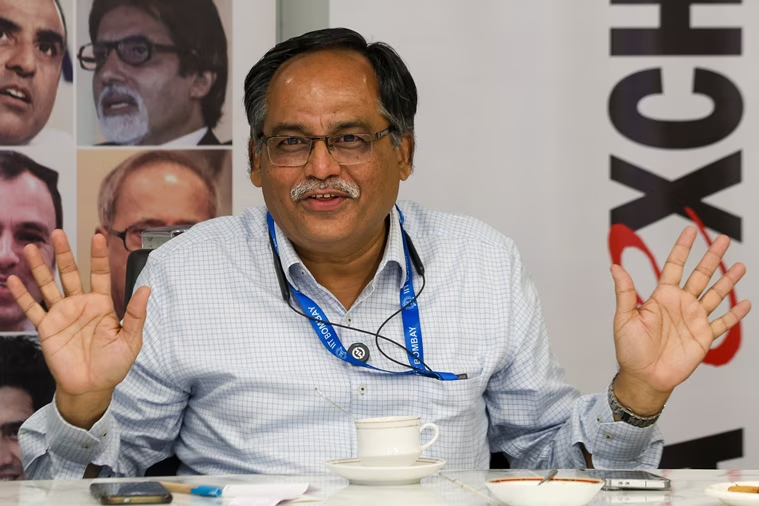
Inaugurated on July 31, 2025, by ISRO Chairman Dr. V. Narayanan, HOPE represents India’s first full-scale analogue space mission. The facility allows scientists and engineers to study human adaptability, life-support systems, and operational protocols in an environment that closely mimics the harsh realities of planetary surfaces—without leaving Earth.
Why Ladakh? A Natural Mars and Moon Analogue
Ladakh’s Tso Kar Valley, situated at an elevation of approximately 4,530 metres (14,860 feet) above sea level, was meticulously chosen for its striking similarities to lunar and Martian landscapes:
- Extreme Cold: Temperatures fluctuate dramatically, often dropping to -10°C or lower.
- High UV Radiation: Intense exposure due to thin atmosphere.
- Low Atmospheric Pressure and Oxygen: Oxygen levels are only about 40% of those at sea level, simulating hypobaric conditions.
- Saline Permafrost and Rocky Terrain: Barren, sandy soil and frozen ground resemble Martian regolith.
- Isolation and Aridity: A cold desert environment with minimal vegetation, ideal for testing isolation effects.
These natural features make Tso Kar one of Earth’s most authentic “Mars on Earth” sites, enabling realistic simulations at a fraction of the cost of actual space missions.
The HOPE Facility: Design and Infrastructure
The HOPE station consists of two interconnected inflatable modules:
- Habitat Module (Hab-1): An 8-metre diameter living space for the crew, equipped with sleeping quarters, a kitchen, sanitation facilities, and circadian lighting to regulate sleep cycles.
- Utility Module: A 5-metre diameter unit housing equipment, life-support systems, hydroponic farming setups for food production, and scientific instruments.
The compact, self-sustaining design replicates essential elements of future planetary habitats, including resource recycling, environmental control, and emergency protocols. Built at a modest cost of around ₹1 crore by private partner Protoplanet, the facility showcases public-private collaboration in India’s space sector.
The Inaugural Mission: A 10-Day Isolation Experiment
The first HOPE analogue mission ran from August 1 to 10, 2025, featuring a two-member “analogue crew”:
- Rahul Mogalapalli: A PhD researcher in aerospace engineering from Purdue University.
- Yaman Akot: A planetary science graduate from the University of Aberdeen.
Selected from 135 applicants based on rigorous medical, psychological, and physical evaluations, the crew underwent a 15-day acclimatisation programme before entering isolation.
During the mission, they conducted experiments focused on:
- Physiological Responses: Monitoring effects of low oxygen, high altitude, and confinement on the body.
- Psychological Resilience: Studying isolation, stress, and team dynamics.
- Epigenetic and Genomic Changes: Analysing how extreme environments alter gene expression.
- Health Monitoring Protocols: Validating wearable tech and medical procedures.
- Microbial Analysis and Sample Collection: Techniques for planetary surface operations.
- Life-Support Validation: Testing hydroponics, air recycling, and resource management.
Real-time data was transmitted via satellite communication, with oversight from ground control.
Leadership and Collaborations
The mission is spearheaded by ISRO’s Human Space Flight Centre (HSFC) in Bengaluru, with key contributions from:
- Protoplanet: Bengaluru-based private firm that designed and constructed the habitat.
- Academic Partners: IIT Bombay, IIST Trivandrum, RGCB Trivandrum, IIT Hyderabad, University of Ladakh, and Institute of Aerospace Medicine (Bengaluru).
- Logistics Support: Mahindra & Mahindra for ground mobility.
This collaborative model aligns with the government’s push for greater private sector involvement in space activities.
Building on Previous Analogue Efforts
HOPE builds upon earlier initiatives:
- Ladakh Human Analogue Mission (LHAM, November 2024): Initial tests in Leh focusing on habitat technologies.
- Anugami Isolation Study (July 2025): A 10-day experiment involving Gaganyaan astronaut Group Captain Angad Pratap.
These stepped-up efforts reflect ISRO’s systematic approach to risk mitigation.
Significance for India’s Space Ambitions
HOPE is a critical “rehearsal for the future,” as described by Dr. Narayanan, directly supporting:
- Gaganyaan Mission: India’s first crewed orbital flight, targeted for the late 2020s.
- Bharatiya Antariksh Station: Planned Indian space station by 2035.
- Crewed Lunar Landing: Ambitious goal by 2040, as envisioned by Prime Minister Narendra Modi.
By addressing human factors—often the most unpredictable element in space exploration—HOPE helps refine protocols for long-duration missions, reduce risks, and develop sustainable technologies like in-situ resource utilisation (ISRU).
Globally, analogue missions are standard practice (e.g., NASA’s NEEMO underwater simulations or Desert RATS in Arizona). India’s entry into this domain positions it alongside space powers like the US, Russia, and China.
Broader Implications and Future Plans
The insights from HOPE will inform astronaut training, habitat design, and psychological support systems. Ladakh is emerging as a hub for astrobiology and planetary science, with parallel studies in nearby Puga Valley uncovering clues about life’s origins.
ISRO plans more extensive analogue missions across the Himalayas and other Indian sites, testing advanced robotics, surface mobility, and longer isolations.
As India accelerates towards becoming a global space leader, initiatives like HOPE embody the nation’s innovative spirit—turning extreme earthly terrains into gateways for interplanetary exploration.
Stay tuned to www.bharattone.com for the latest updates on ISRO’s milestones, space technology advancements, and India’s journey to the stars.

