





















































































































































India Set to Transition to Upper Middle-Income Country by 2030 with Per Capita Income of $4,000: SBI Research Report


India Set to Transition to Upper Middle-Income Country by 2030 with Per Capita Income of $4,000: SBI Research Report
Hyderabad, January 19, 2026 — India is on track to become an upper middle-income country by 2030, achieving a per capita income of approximately $4,000, according to a recent research report from the State Bank of India (SBI). This milestone would place India alongside nations like China and Indonesia in the World Bank’s current classification system.
The SBI Ecowrap report, released on January 19, 2026, highlights India’s accelerated economic progress. The country is expected to reach this threshold in the next four years, transitioning from its current lower-middle-income status, which it attained in 2007 after roughly 60 years of moving out of the low-income category.
Key highlights from the report include:
- India’s per capita gross national income (GNI) milestones: It crossed $1,000 in 2009 (62 years post-independence), doubled to $2,000 by 2019, and is projected to hit $3,000 by 2026.
- By 2030, per capita income is forecasted to touch $4,000, meeting or approaching the current World Bank threshold for upper-middle-income economies (around $4,500).
- The report notes that nominal GDP growth in dollar terms of about 11.5% annually would be required for this transition—a pace India has achieved in pre-pandemic periods (around 11% from FY04–FY20) and remained close to in recent years.
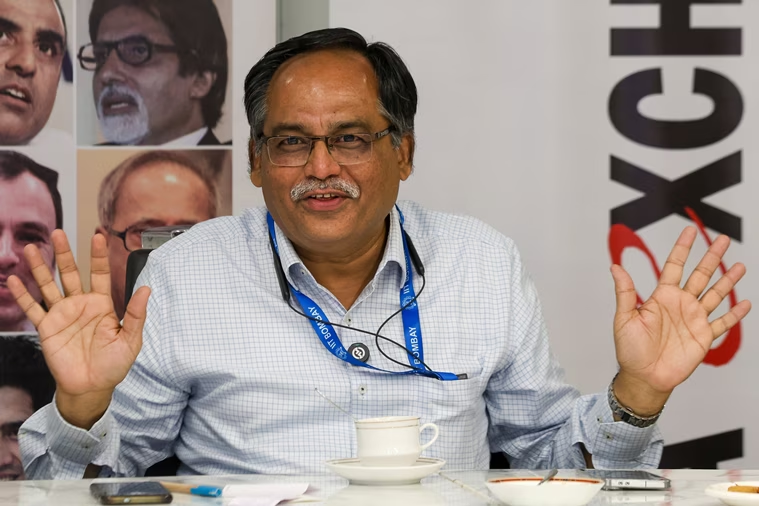
Dr. Soumya Kanti Ghosh, Group Chief Economic Advisor at SBI, emphasized the accelerating trajectory: “India is set to touch $4,000 per capita in another 4 years in 2030 to transition to an Upper Middle Income country and join China and Indonesia at current classification.”
The analysis also points to India’s improving global standing. Over the past decade, the country’s percentile rank in average real GDP growth among emerging economies has risen from the 92nd to the 95th percentile, placing it deeper in the upper tail of global growth distribution.
Looking further ahead to the “Viksit Bharat” vision of achieving high-income status by 2047:
- To reach the current high-income threshold of $13,936 per capita GNI, India would need a compound annual growth rate (CAGR) of 7.5% in per capita GNI—achievable given the 8.3% CAGR observed from 2001–2024.
- However, thresholds are likely to rise (potentially to $18,000), requiring a higher CAGR of around 8.9% over the next 23 years.
- Sustained reforms will be essential to maintain momentum and secure the incremental growth needed for high-income status.
The report underscores India’s broader economic milestones, such as reaching a $4 trillion GDP in 2025 and potentially $5 trillion within the next two years, positioning it to become the world’s third-largest economy by 2028.
This projection signals a significant shift in India’s income profile and reflects sustained policy efforts, structural reforms, and robust growth drivers driving the nation’s economic ascent.