









































































































































Traffic Challan SMS Scam Alert 2026: Verify First

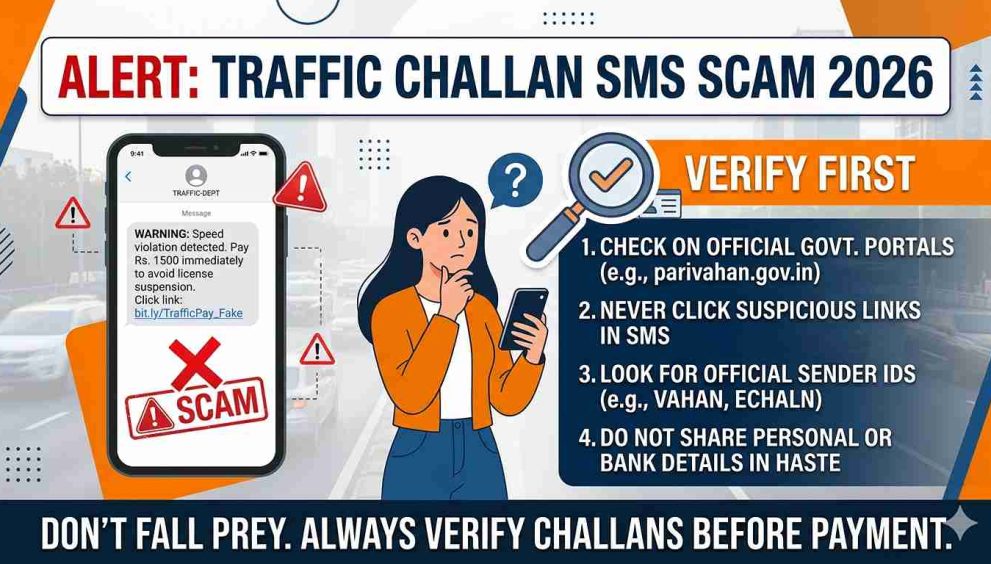
Received an unexpected traffic challan message on your phone saying “Pay now or face higher penalty”? STOP! Don’t click any link. This is one of the fastest-growing cyber scams in India right now.
Cybercriminals are sending fake e-challan SMS and WhatsApp messages that look almost official. They create panic with small fine amounts (₹300–₹3000) and urge you to “verify and pay immediately” through a link. Many Indians have already lost lakhs of rupees after entering card details or OTP on fake websites.
In this BharatTone guide, we explain the new traffic challan cyber scam 2026, how it works, red flags, and most importantly — how to safely verify any challan before paying.
How the Fake Traffic Challan Scam Works
- You receive an SMS or WhatsApp message: “A traffic challan of ₹590 has been issued against your vehicle [number]. Click here to view and pay: [suspicious link]”
- The message uses official-looking language and sometimes shows a real-looking challan number.
- The link takes you to a fake website that closely mimics the government portal (e.g., echallan.pasvahan.icu instead of echallan.parivahan.gov.in).
- Once you enter your vehicle details, card information, and OTP — scammers drain your account. In one Delhi case, a senior citizen lost over ₹2.5 lakh over a fake ₹500 fine.
Scammers often use urgency (“Pay within 24 hours or licence will be suspended”) and even fake caller IDs to make it seem genuine.
Red Flags – Spot the Scam Instantly
- Unsolicited SMS/WhatsApp with a direct payment link
- Link does not end with .gov.in (official government sites only)
- Spelling mistakes or slightly different domain names
- Pressure to pay quickly or share OTP/CVV
- Asking for card details on a non-government website
- Message from unknown short code or random number
Remember: Real traffic police or RTO never send direct payment links via SMS/WhatsApp asking for personal banking details.
How to Safely Verify Traffic Challan (Official Way – 100% Safe)
Step-by-Step Guide (Do This Every Time):
- Never click the link in the message.
- Open your browser and manually type the official website: → echallan.parivahan.gov.in
- Click on “Check Challan Status”
- Enter your Vehicle Registration Number (and last 5 digits of chassis/engine number if asked).
- Solve the captcha and click “Get Detail”
If no challan appears → the SMS was fake. Ignore and delete it.
Alternative Safe Options:
- Download the official mParivahan App from Google Play Store or Apple App Store only.
- Check on your state traffic police website (search “[Your State] Traffic Police Official”).
What to Do If You Already Clicked the Fake Link or Paid
- Immediately contact your bank and block the card / request reversal.
- Change all passwords and enable two-factor authentication.
- Report the fraud: – Call 1930 (National Cyber Crime Helpline) – File complaint at cybercrime
- Monitor your bank statements for the next few days.
Government & Police Advisory (March 2026)
Multiple states and cyber cells (including Maharashtra Cyber, Delhi Police) have issued alerts: “Verify e-challans only on official government portals. Do not click unknown links or install any APK files sent via messages.”
BharatTone Tips to Stay Safe from Cyber Scams
- Always type government URLs manually — never click from messages.
- Keep bank SMS alerts ON for instant transaction notifications.
- Use UPI with caution and set low transaction limits if needed.
- Educate family members — especially senior citizens who drive.
- Install a reliable antivirus with phishing protection on your phone.
Bottom Line: An unexpected traffic challan message is now a major red flag in 2026. Verify before you pay — it takes just 30 seconds on the official Parivahan portal and can save you from losing hard-earned money.
Stay alert, stay safe, and drive responsibly. Real challans can always be checked and paid peacefully on government websites without any panic.
Jai Hind! Drive safe and cyber safe!
Share this important alert with your family and WhatsApp groups.
Tell us in the comments: Have you received any suspicious traffic challan message recently?